Description
n8n-nodes-virustotal
An n8n community node for the VirusTotal API v3.
It looks up and scans files, URLs, domains and IP addresses, returns a normalized verdict your workflow
can branch on, and includes a polling trigger that fires when a watched indicator changes verdict.
> Unofficial. This project is not affiliated with, endorsed by, or sponsored by VirusTotal or Google.
> VirusTotal is a trademark of its owner. The node icon is an original drawing.
Installation ·
Credentials ·
Nodes and operations ·
Verdict ·
Trigger ·
Privacy ·
Terms of use ·
Compatibility ·
Development
Demo

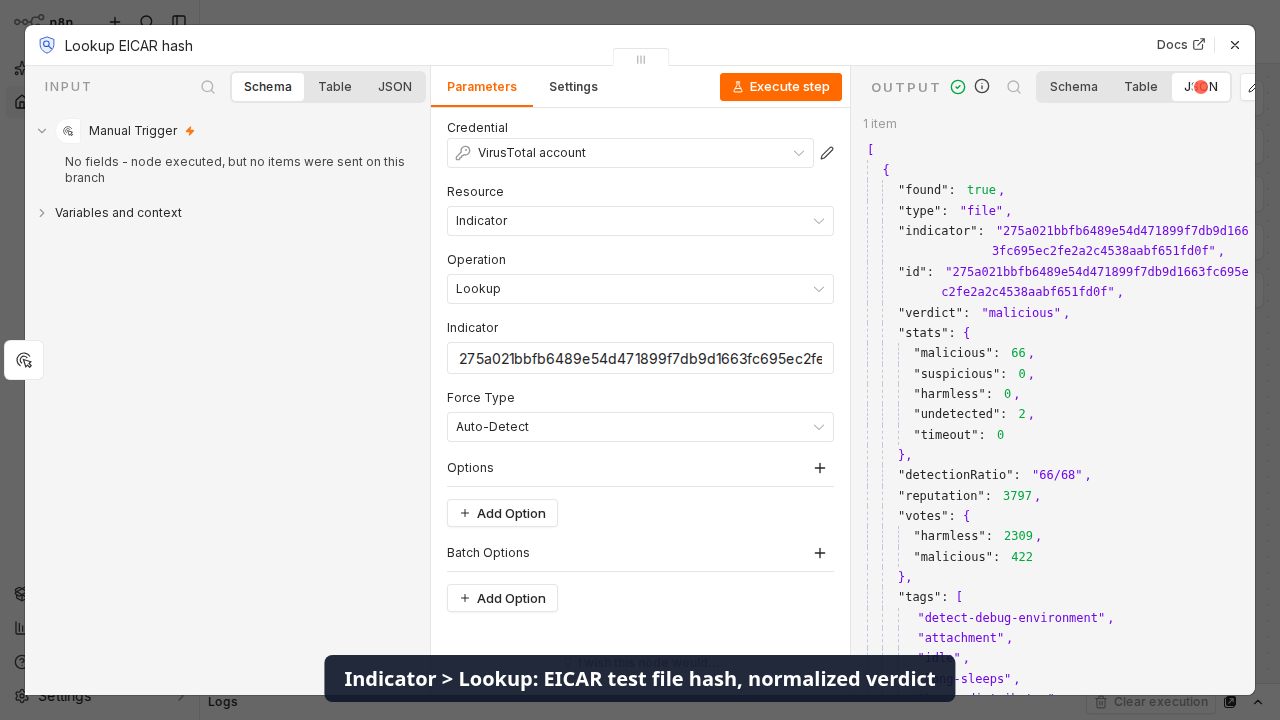
Click the image to watch the demo: indicator lookup with a normalized verdict, a defanged URL, an unknown hash and the
quota check. Importable example workflows are in examples/.
Why this node
n8n core ships only a credential for VirusTotal, to be used with the HTTP Request node. It has no operations.
This package adds real nodes, and differs in these ways:
- English UI and descriptions written so AI agents can choose the right operation (
usableAsTool). - Normalized verdict (
malicious,suspicious,clean,unknown) with configurable thresholds. - Built-in rate limiting for the public tier: requests are spaced to your per-minute quota, so a batch does not fail with 429.
- Safe handling of unknown indicators: an unseen hash returns an
unknownitem instead of failing the workflow. - A watch-list trigger that detects verdict changes.
Installation
In n8n, go to Settings → Community Nodes → Install and enter:
@t0mer/n8n-nodes-virustotal
See the community nodes installation guide.
Or install it with npm in your n8n installation folder:
npm install @t0mer/n8n-nodes-virustotal
Credentials
Create a VirusTotal API credential.
1. Sign up at virustotal.com, then open your profile menu and choose API key.
2. Paste the key into the credential.
| Field | Default | Description |
|—|—|—|
| API Key | | Sent as the x-apikey header on every request. |
| Tier | Public | Set to Premium if your key is a Premium key. Premium-only operations refuse to run on Public. |
| Requests per Minute | 4 | Client-side throttle applied to every request. Keep 4 on the public tier. Raise it to match your Premium contract. |
The credential test calls GET /users/{apiKey}. It costs one request.
Tiers and quotas
| Tier | Quota |
|—|—|
| Public | 4 requests/minute, 500/day, 15.5K/month |
| Premium | Depends on your contract |
Every lookup, poll, comment and search counts toward the quota. The node never hard-codes Premium limits.
Nodes and operations
The package provides two nodes:
Shared behaviour
Lookup operations have an Options collection:
| Option | Default | Description |
|—|—|—|
| Output | Summary | Summary is the normalized shape below. Raw returns the VirusTotal object unchanged. |
| On Not Found | Return Unknown Item | { found: false, type, indicator, verdict: "unknown" }, or throw an error. |
| Malicious Threshold | 3 | Engines needed for a malicious verdict. |
| Suspicious Threshold | 1 | Malicious plus suspicious engines needed for a suspicious verdict. |
| Include Engine Results | off | Adds engines: { engine, category, result } for engines that flagged the indicator. |
A Summary item looks like this:
{
  "found": true,
  "type": "file",
  "indicator": "275a021b…fd0f",
  "id": "275a021b…fd0f",
  "verdict": "malicious",
  "stats": { "malicious": 62, "suspicious": 1, "harmless": 0, "undetected": 8, "timeout": 0 },
  "detectionRatio": "62/71",
  "reputation": -42,
  "votes": { "harmless": 3, "malicious": 210 },
  "tags": ["eicar"],
  "lastAnalysisDate": "2026-09-22T07:33:20.000Z",
  "permalink": "https://www.virustotal.com/gui/file/275a021b…fd0f"
}
Timestamps are converted from epoch seconds to ISO-8601. Keys that VirusTotal does not return are omitted, never undefined.
Per type, the Summary adds:
sha256, sha1, md5, meaningfulName, names (first 10), size, typeDescription, typeTag, firstSubmissionDate, timesSubmitted, popularThreatLabel, sandboxVerdictsurl, finalUrl, title, categories, lastHttpResponseCodecategories, registrar, creationDate, lastDnsRecords, lastHttpsCertificate (issuer, subject, notAfter, daysUntilExpiry), whoisDateasn, asOwner, country, network, regionalInternetRegistryItems are processed one at a time, through the throttle. Continue On Fail is supported: a failed item becomes
{ error, indicator } (plus statusCode for API errors). pairedItem is kept on every output item. The optional quota
check below runs before any item and, if it fails, stops the whole run regardless of Continue On Fail.
The node also has a Batch Options collection with Check Quota Before Batch (default off). When on, and the batch is
estimated at more than 10 requests, the node reads your quota once (one request, through the throttle) and fails before
processing any item if the remaining apirequestsdaily budget is smaller than the estimate. The estimate is
deliberately rough: 1 request per item, 5 per scan or rescan that waits for the result, 2 per scan that only submits,
and 3 for an operation set to Return All.
Indicator
Lookup: the default way to check any indicator of compromise. Give it a hash, URL, domain or IP and it detects the
type. Detection order is hash (MD5, SHA-1, SHA-256), URL, IP, domain. “Defanged” input such as hxxp://example[.]com,
1.2.3[.]4 or example[dot]com is refanged first, and the output shows the normalized value. Use Force Type for
ambiguous input. A host with a path but no scheme, such as example.com/login, is treated as a URL.
File
| Operation | Notes |
|—|—|
| Get Report | By MD5, SHA-1 or SHA-256. |
| Scan | Uploads a file from a binary property. See below. |
| Rescan | Asks VirusTotal to analyse a known hash again. |
| Get Behaviour Summary | Merged sandbox behaviour. |
| Get MITRE ATT&CK | ATT&CK tactics and techniques per sandbox. |
| Get Related | Relationship dropdown, with Return All / Limit. |
| Get Download URL | Premium only. Returns a temporary URL. The node never downloads the sample. |
Scan options:
Wait for Result (default) uploads, polls the analysis, then returns the file report. Submit Only returns the analysis id at once; use Analysis → Get later.uploaded: false and analysisId: null (in both modes, so downstream nodes can read analysisId either way). This saves quota and avoids sharing files VirusTotal already knows.max(20, 60 / requestsPerMinute × 1.5) seconds, with a 10 minute timeout. On timeout the error contains the analysis id.URL
Get Report, Scan, Rescan, Get Related. The node computes VirusTotal’s URL id (unpadded base64url) itself, so you
pass the URL as is. Scan and Rescan have the same Mode options as file scans.
Domain
Get Report, Get Related (subdomains, siblings, communicating files, historical WHOIS and SSL, …) and
Get DNS Resolutions, a shortcut to the resolutions relationship.
IP Address
Get Report and Get Related. IPv4 and IPv6 are supported.
Analysis
Get: status, stats and, once completed, the analysed object id (itemType, itemId).
Comment and Vote
harmless or malicious). A duplicate vote (409) is treated as success and returns alreadyVoted: true.Search
Order.Account
{ quota: { name, used, allowed, remaining } }, so a workflow can check its budget before a bulk job.Premium-only operations
n8n cannot hide parameters based on credential fields, so Premium-only operations are labelled “Premium only” in their description
and enforced at run time: on a Public credential they fail immediately with a clear message, without spending a request.
A 403 ForbiddenError from VirusTotal on a relationship is reported as “requires a Premium key”. Which relationships need Premium depends
on your VirusTotal plan; the dropdown marks the ones that commonly do.
Examples
Branch on a verdict. Indicator → Lookup with {{ $json.url }}, then an IF node on {{ $json.verdict }} equals malicious.
Scan an email attachment. Email trigger → File → Scan (Mode: Wait for Result, binary property data) → IF on verdict.
With Check Hash First on, repeated attachments cost one request each.
Budget check before a bulk job. Account → Get Quotas, then stop if quota.remaining for apirequestsdaily is lower than your item count.
The verdict heuristic
malicious >= Malicious Threshold                         -> malicious
malicious + suspicious >= Suspicious Threshold           -> suspicious
engines analysed the object and flagged nothing          -> clean
no report, or no engine results at all                   -> unknown
detectionRatio is malicious / total, where total counts malicious, suspicious, harmless and undetected engines and
excludes type-unsupported, failure and timeout. The verdict is a heuristic, not a guarantee. Tune the thresholds to your
risk tolerance, and treat clean as “no engine objected”, not as “safe”.
VirusTotal Trigger
A polling trigger with two events. It never blocks and never waits for an analysis.
Watched Indicator Changed
Watches a list of hashes, URLs, domains and IPs (types are detected automatically). Fire When:
Verdict Changes (default), Becomes Malicious, or Malicious Count Increases.
Output items are the Summary plus event, previousVerdict and previousStats.
unknown; the move from unknown to a known verdict counts as a change.429 the trigger ends that poll quietly and keeps its position. A 401 raises an error.Quota math. Each lookup is one request. With N indicators, L lookups per poll and a poll every P minutes:
ceil(N / L) × P minutes;L × 1440 / P requests.| Poll interval | Lookups per poll | Requests per day | Refresh time for 30 indicators |
|—|—|—|—|
| 1 minute | 3 | 4,320 | 10 min |
| 5 minutes | 3 | 864 | 50 min |
| 15 minutes | 3 | 288 | 150 min |
| 30 minutes | 3 | 144 | 300 min |
The public tier allows 500 requests per day, and every other node in your workflows shares that budget. On the public tier, use
a poll interval of 15 minutes or more, or keep the list short. The one-minute row is only realistic on a Premium key.
Livehunt Notification (Premium only)
Emits one item per new Livehunt notification file: notification id and date, rule name, ruleset, tags and a file Summary.
Ruleset Filter is optional; a plain name is sent as tag:, and a value containing : is sent unchanged as the
VirusTotal filter. Notifications are de-duplicated by id (the last 1,000 ids are kept). The first poll records a baseline.
It requires the credential Tier to be Premium.
Trigger state is stored in the workflow static data with stateVersion: 1.
Error handling
| HTTP / VirusTotal code | What the node does |
|—|—|
| 400 BadRequestError, InvalidArgumentError | No retry. Shows VirusTotal’s message. |
| 400 NotAvailableYet | Retries with backoff (2 s, 4 s, 8 s). |
| 401 | No retry. “Invalid or inactive VirusTotal API key”. |
| 403 | No retry. Says a Premium key may be required. |
| 404 | Not an error for lookups; see On Not Found. |
| 409 | A duplicate vote is treated as success. |
| 429 | Waits one minute and retries at most twice, then reports the exhausted quota. |
| 503, 504 | Retries with backoff (2 s, 4 s, 8 s). |
The API key is never logged or included in error output.
Privacy
Read this before using the scan operations.
Terms of use of the public API
The VirusTotal public API is for non-commercial use only, and may not be used in commercial products or services.
Use a Premium key for commercial use. You are responsible for complying with the
VirusTotal terms of service.
Compatibility
n8nNodesApiVersion 1) and this.helpers.httpRequestWithAuthentication.n8n-workflow.Development
npm ci
npm run lint      # n8n-node lint (strict)
npm run build
npm test          # vitest; CI never calls the real API
npm run dev       # runs n8n with the node loaded
npm run dev loads node definitions once at startup: restart it (and hard-refresh the browser) after adding operations.
Layout:
credentials/VirusTotalApi.credentials.ts
nodes/VirusTotal/           action node; resources/ holds one file per resource
nodes/VirusTotalTrigger/    polling trigger
shared/                     transport, throttle, indicator, verdict, summary, poll, upload, paginate, watch, livehunt
test/                       unit tests and fixtures
Releases use date-based versions (YYYY.M.PATCH). Pushing a tag publishes to npm with provenance.