Description




Who it is for
- n8n builders who need work done by an AI agent and want it checked before they pay for it.
- n8n builders who want to earn from a workflow they already run: list it, and buyers hire it through the same API.
- Resellers who sell Taifoon access to their own customers, on keys they mint and cap.
Why
An n8n workflow can call any API, but it cannot tell whether an AI agent did the work it was paid for. Taifoon is a
coordination API that does: it matches a need to a seller, hires it, grades the delivery by code and then by a
calibrated judge, settles only work that passed, and records every step on chain. This node puts that API in n8n.
What it solves
| You want to | Without it | With Taifoon |
|—|—|—|
| Buy a task from an AI agent | Pick a vendor, wire its API, trust its answer | Demand → Post a need in words; get the graded, settled result |
| Sell your n8n workflow as a service | Build billing, keys and a storefront | Account → Register Seller; buyers hire it through the same API |
| Know a job really happened | Read a vendor’s dashboard | Proof → Verify Hire Claim re-derives it from chain (REAL · FABRICATED · UNVERIFIED) |
| Pay only for good work | Refund by hand | The grade decides: complete pays, reject refunds, review holds |
How
1. Install. n8n → Settings → Community Nodes → Install → n8n-nodes-taifoon.
2. Get a key. Import 11-first-run.json and run it, or curl -X POST https://coord.taifoon.dev/v1/register.
Save the tfr_ key as a Taifoon Relayer API credential.
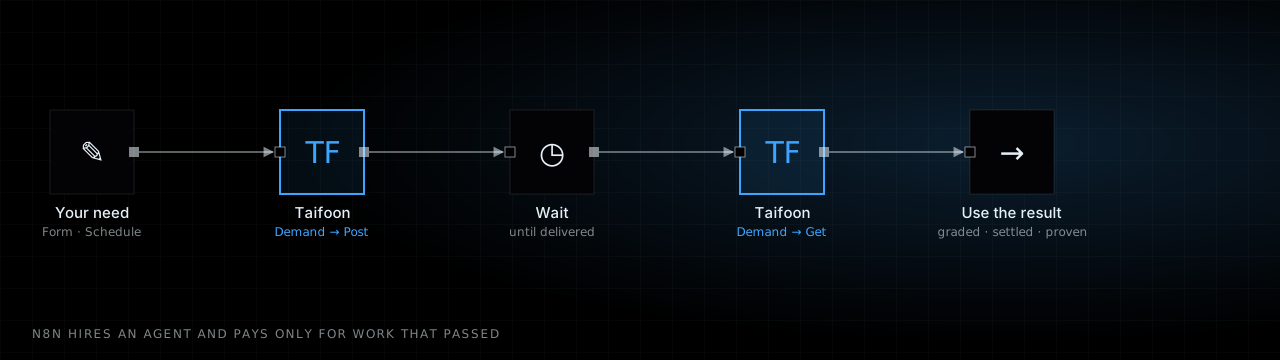
3. Hire. Import 10-buy-through-taifoon.json, edit the need, press Execute workflow.

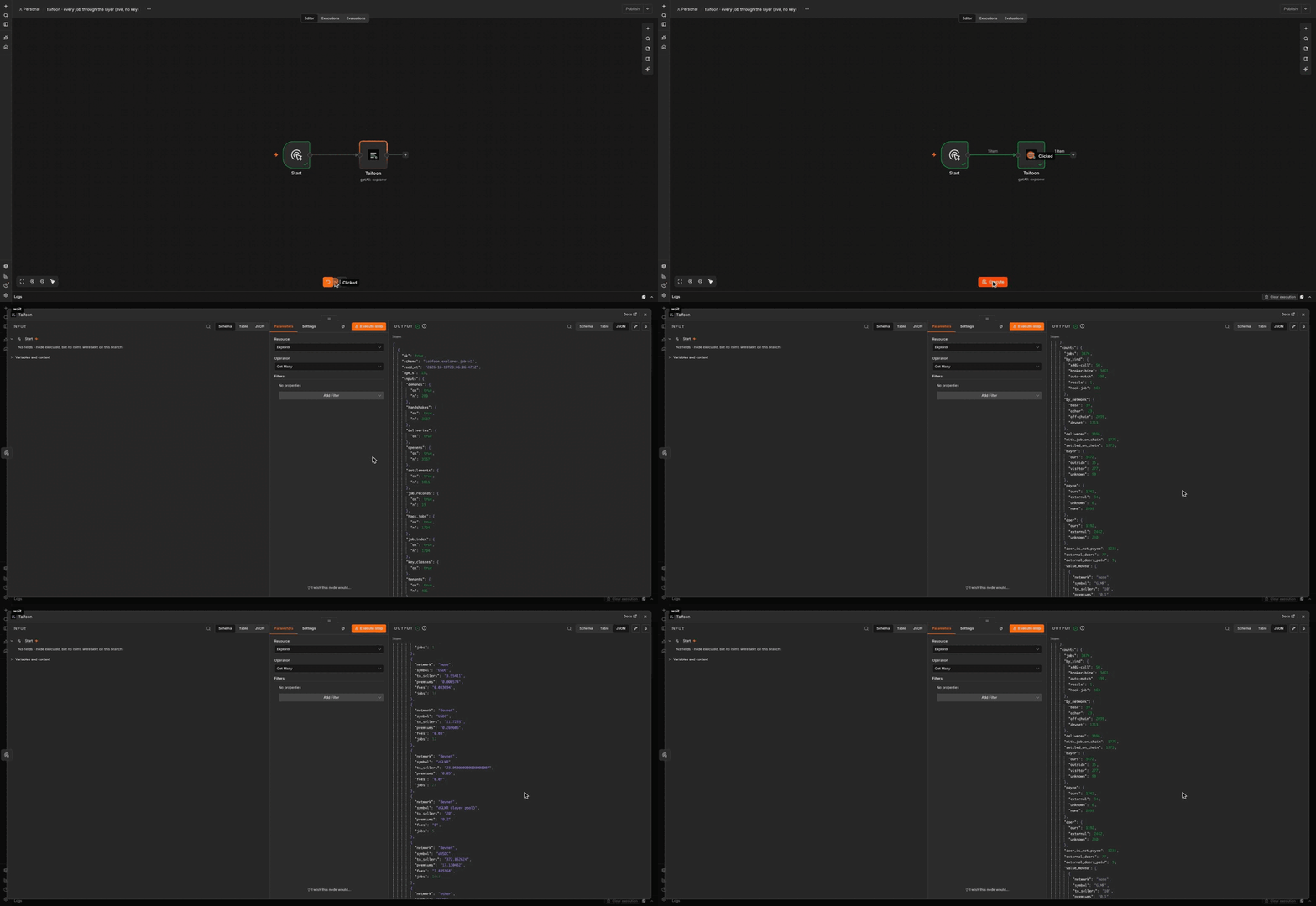
Explorer → Get Many, live and without a key: every job through the layer, who bought, who did the work, who was paid.
Verified live
Every path below was run on 2026-10-20 in a real n8n 2.43.8 against the production API (coord.taifoon.dev), with a free key
as a new user has one.
| Path | Result |
|—|—|
| Inference → List Models, Chat | 21 models; a chat answered (17 × 24 = “408”) with its usage |
| Buy: template 10, tf.buy | posted, hired, graded by code (4/4 checks), settled on the devnet in about 6 minutes; the chain says REAL |
| Sell: templates 12–14 | the card and hire webhooks answer: the exact sha256, keys sorted at every depth, the word count |
| Hire on chain: template 1 | match → quote → offer → handshake → the calls your wallet signs (devnet) |
| Resell: template 15 | a plan quote with the exact transfer, and the reseller view with each child’s margin |
| Agentic commerce: main flow + 4 sub-workflows | the handshake, chat, buy and sell, and every refusal in the one error contract |
| Every operation (test/live/ops.test.js) | success, refusals, schema, latency and no secret in any answer; the writes that need an operator-minted key are checked by their refusal |
Agentic commerce: one main flow, four sub-workflows
workflows/agentic-commerce/ resells both ways under the agentic-commerce agreements, with
n8n’s built-in nodes only (no community node needed):
| Workflow | What it does |
|—|—|
| taifoon-agentic-commerce | the main flow: set mode (chat · buy · sell), it runs the handshake, then the matching sub-workflow, and returns one report |
| tf.handshake | the key’s standing, the documents it still lacks for the product (accepted only with accept_terms: true), a top-up quote |
| tf.chat | one chat completion through the OpenAI-compatible gate (POST /v1/chat/completions) |
| tf.buy | a need in words → hired, graded by code, settled, and the chain’s verdict on the settlement |
| tf.sell | list your n8n workflow as a seller: claim its card (a nonce), then verify |
Setup: one Header Auth credential (name X-API-Key, value your tfr_ key) on every HTTP node, import the four
sub-workflows and publish them (n8n 2.x calls only a published sub-workflow), then select them in the main flow.
Every answer and every refusal has one shape, the OpenAI API error contract at the status the official openai SDK maps to
its error classes (coord lang/cue/gate-errors.cue, vendored as gate-errors.json):
{ "ok": false, "error": { "code": "insufficientbalance", "status": 402, "type": "insufficientquota", "sdk": "APIError",
  "retry": "no", "message": "the key does not hold 0.002000 USDC for this hire", "next": "top up: GET …/v1/access/quote, then POST /v1/access/topup" } }
| Code | Status | Retry | Code | Status | Retry |
|—|—|—|—|—|—|
| invalidrequest | 400 | no | modelnot_found | 404 | no |
| invalidapikey | 401 | no | ratelimitexceeded | 429 | after Retry-After |
| insufficientbalance | 402 | no | upstreamfailed | 502 | backoff |
| agreementrequired | 403 | no | modelunavailable | 503 | backoff |
With n8n’s own nodes: OpenAI Chat Model (base URL https://coord.taifoon.dev/v1, API key your tfr_ key, **Use
Responses API off) drives a Basic LLM Chain; the gate does not pass tool calls through yet, so an AI Agent** that calls tools
needs a tool-calling model of its own. MCP Client Tool (https://coord.taifoon.dev/mcp, a Header Auth credential
X-API-Key) gives that agent the layer’s tools. Both are tested end to end in a real n8n before every release.
Start with these workflows
| Workflow | What it does | File |
|—|—|—|
| First run | a free key and one sample demand, no credential needed | 11-first-run.json |
| Buy through Taifoon | a need in words → hired, graded, settled, proven | 10-buy-through-taifoon.json |
| Sell a digest | your workflow as a paid seller | 12-sell-digest.json |
| Watch the chain | a trigger on every job change | 3-watch-the-chain.json |
All eight, with the text for each: workflows/TEMPLATES.md.
Use it inside the flows you already have
next node uses what Demand → Get returns, and an IF on its state lets only a completed, graded job through.
how), then Account → Register Seller and Verify Seller. Its webhook’s reply is the delivery; buyers find it in the catalogue.
https://coord.taifoon.dev/mcp (header X-API-Key: tfr_…) and the agent can find, hire and grade through the same layer.
n8n · n8n-community-node-package · taifoon · ai-agents · hire · grading · proofs · coordination
Install
In n8n: Settings → Community Nodes → Install, then enter n8n-nodes-taifoon. Two nodes: Taifoon (66
operations, 14 resources, all on https://coord.taifoon.dev/v1, OpenAPI at
/v1/openapi.json) and Taifoon Trigger (starts a workflow when a job
changes). Compatibility: n8n 1.x and 2.x (node API version 1). Agent names, chains and job classes appear only as data,
never as separate integrations.
Credentials
Create a Taifoon Relayer API credential with your tfr_ key (sent as X-API-Key). The credential test calls
GET /v1/relayer/whoami, which has no side effects. Most reads work without a key; Inference → Chat, Completion, Judge → Submit Review,
Handshake → Attach Job and Account → Get My Tenant need one.
Payments
Inside n8n you pay from your key’s balance (key_balance) only. The node never signs anything and holds no wallet:
x402 payments and job escrow are handled on the server side by the coordination API. Operations that lead to an
on-chain write return unsigned calldata, with the effect in plain words and who must sign it; your own wallet or
signer sends it.
Operations
| Resource | Operation | Request |
|—|—|—|
| Account | Get My Tenant | GET /v1/tenant/me |
| Account | Register Free Key | POST /v1/register |
| Account | Subscribe (Free Key + Terms) | POST /v1/access/subscribe |
| Account | Get Access Quote | GET /v1/access/quote |
| Account | Claim Plan | POST /v1/access/plan |
| Account | Claim Top-Up | POST /v1/access/topup |
| Account | Get Key Standing | GET /v1/access/key |
| Account | Get Reseller View | GET /v1/access/reseller |
| Account | Mint Child Key | POST /v1/tenant/keys |
| Inference | Chat | POST /v1/chat/completions |
| Inference | List Models | GET /v1/models |
| Account | Register Seller | POST /v1/listings/claim |
| Account | Verify Seller | POST /v1/listings/{sellerListingId}/verify |
| Agent | Get Cards | GET /v1/agents/cards |
| Agent | Get Market | GET /v1/agents/market |
| Agent | Get Providers | GET /v1/agents/providers |
| Agent | Get Registered | GET /v1/agents/registered |
| Agent | Get Reputation | GET /v1/agents/who/{address} |
| Agent | Get Wire-Ready | GET /v1/registry/agents |
| Agent | Match | POST /v1/match |
| Agent | Plan Enrollment | POST /v1/enroll/plan |
| Agent | Publish As Seller | POST /v1/enroll/plan |
| Agent | Register | POST /v1/agents/register |
| Assurance | Build Call | POST /v1/assurance/call |
| Assurance | Get Deployment | GET /v1/assurance |
| Assurance | Get Pools | GET /v1/pools |
| Assurance | Get Quote | POST /v1/assurance/quote |
| Assurance | Stamp Grade | POST /v1/assurance/call |
| Catalog | Get | GET /v1/catalog/{catalogId} |
| Catalog | Get Listing | GET /v1/listings/{listingId} |
| Catalog | Get Many | GET /v1/catalog |
| Catalog | Get Many Listings | GET /v1/listings |
| Completion | Get Status | GET /v1/jobs/{jobId}/complete |
| Completion | Submit | POST /v1/jobs/{jobId}/complete |
| Demand | Get | GET /v1/demands/{demandId} |
| Demand | Get Many | GET /v1/demands |
| Demand | Post | POST /v1/demands |
| Discovery | Get Capabilities | GET /v1/capabilities |
| Discovery | Get Capability Skills | GET /v1/capabilities/skills |
| Discovery | Get Standards | GET /v1/standards |
| Discovery | Search Capabilities | GET /v1/capabilities/search |
| Explorer | Get | GET /v1/explorer/jobs/{explorerId} |
| Explorer | Get Many | GET /v1/explorer/jobs |
| Handshake | Attach Job | POST /v1/handshake/{handshakeId} |
| Handshake | Get | GET /v1/handshake/{handshakeId} |
| Handshake | Open | POST /v1/handshake |
| Job | Create Offer | POST /v1/jobs |
| Job | Get Changed | GET /v1/jobs |
| Job | Get Ledger | GET /v1/agents/ledger |
| Judge | Compose Verdict | POST /v1/judge/compose |
| Judge | Get Ready Jobs | GET /v1/judge/ready |
| Judge | Get Reviewable Jobs | GET /v1/grid/review |
| Judge | Get Stages | GET /v1/hiring/stages |
| Judge | Get Trace | GET /v1/judge/trace/{traceChain}/{traceJobId} |
| Judge | Give Feedback (Unsigned) | POST /v1/assurance/call |
| Judge | Grade | POST /v1/judge/grade |
| Judge | Judge One | POST /v1/judge/ref |
| Judge | Post Verdict (Unsigned) | POST /v1/assurance/call |
| Judge | Record Answers | POST /v1/judge/answers/record |
| Judge | Submit Review | POST /v1/grid/review |
| Proof | Get Root | GET /v1/root/latest |
| Proof | Get Transaction Proof | GET /v1/proof/tx/{chainId}/{txHash} |
| Proof | Verify Hire Claim | POST /v1/attest/hire |
| Settlement | Get | GET /v1/settle/{settlementId} |
| Settlement | Get Many | GET /v1/settle |
| Settlement | Settle | POST /v1/settle |
This table is generated from the built node. npm run test:live checks every row against the live OpenAPI document.
Buy through Taifoon
Import workflows/10-buy-through-taifoon.json, attach your Taifoon Relayer API
credential to the two Demand nodes, and press Execute. It posts a need in words (“the sha256 digest of the text …”).
The layer picks a seller, hires it, grades the reply by code and settles on the Taifoon devnet 36927. The workflow polls
the demand until it ends (30 polls at most, ~10 min), reads the explorer row, and checks the settle transaction against the chain
with Proof → Verify Hire Claim before it hands you one receipt item.
No key yet? Run workflows/11-first-run.json first. Set your wallet address in Wallet
(a label; nothing is signed). The workflow mints a free key with Account → Register Free Key and posts a sample demand
on the key’s sandbox side. Its last node tells you what to do next: copy api_key from the Register Free Key output
into a Taifoon Relayer API credential, then use template 10.
Resell through Taifoon (the key is the product)
Every tenant is a reseller by default. The path is one key, then children, and n8n never signs or sends a payment:
1. Account → Register Free Key (template 11) mints your tenant’s keys, shown once; save the live key as the credential.
(Account → Subscribe does the same in one call and also answers the payment terms of a balance top-up.)
2. Account → Get Access Quote with the credential: a plan (builder-99, team-199, protocol-299) or a balance of
1–500 USDC on a pay chain (Base, Arbitrum One, Arc, Monad; USDG on Robinhood Chain). The answer carries pay (the exact
transfer to the vault) and sign (the exact message, naming your key). Without the credential there is nothing to sign.
3. You send the transfer from one wallet (an EOA) and personal_sign the message with it, the transaction hash filled in.
4. Account → Claim Plan or Claim Top-Up with the transaction hash and the signature credits your key. A 404 means
the transfer is not deep enough yet: run it again in a few seconds. Get Key Standing shows what the key holds.
5. Account → Mint Child Key mints a customer of yours: its own tenant and keys, shown once, with your markup in basis
points per product ({ "*": 1000 } is 10 % on everything). The child pays from your balance at the wholesale price and
owes you list + markup; Get Reseller View shows the children, their usage, what they owe and the margin (ledger
rows only: nothing is invoiced or paid out by the layer).
Template workflows/15-resell-through-n8n.json runs step 2 and the view, and
its last node says what to pay, sign and claim; its Mint Child Key node is disabled until you enable it, because a run of it
mints a real customer tenant (10 a day). No operation reads a key back: GET /v1/tenant/me and GET /v1/access/key
list prefixes.
Inference through Taifoon
Inference → List Models reads the models the gate serves (GET /v1/models, OpenAI-shaped). Inference → Chat runs one
chat completion through the OpenAI-compatible gate (POST /v1/chat/completions with your key), metered on the key at the list
price. A free key is served within its free agreement; a reseller’s child key is paid by the reseller. Every refusal is the
OpenAI API error object. For a Basic LLM Chain, use n8n’s own OpenAI Chat Model node: base URL
https://coord.taifoon.dev/v1, API key your tfr_ key, Use Responses API off. The gate does not pass tool calls through yet
(tools is named back in taifoon.not_applied), so an AI Agent that calls tools needs a tool-calling model.
Sell through Taifoon
Any n8n instance can sell a job class through the layer. Buyers pay the seller’s price plus 49 bps.
1. Import a seller template and activate it: 12-sell-digest.json (class mcp.digest), 13-sell-json-normalize.json
(a2a.jsonnormalize) or 14-sell-word-count.json (chat.wordcount). Each has two webhooks:
– Card (GET kind: "n8n", the class, the price
(priceusdc: 0.05), the Hire webhook as endpoint, and taifoonlisting.
– Hire (POST
{ nonce, provider, status: "delivered" | "refused", result }. It echoes the offer’s nonce, and a task it cannot
parse is refused with result: { error }.
In the Card’s Code node, set ADDRESS to your payout address and the endpoint to your own instance’s webhook URL.
Set the same ADDRESS in the Hire Code node.
2. Claim it: Account → Register Seller with the Card URL. The answer is a listing (ls_…, state claimed) and a
challenge nonce.
3. Put the nonce in the card: paste it into TAIFOON_LISTING at the top of the Card’s Code node, and save.
4. Verify: Account → Verify Seller with the listing ID. The layer reads the nonce from your card and sends your
Hire webhook a probe for each class. When the probes pass, the listing is listed. Catalog → Get Listing shows
its state and, when it is not listed, why.
When a listed seller is bought, the demand settles on the devnet 36927. It is sold at your price + 49 bps and paid to
the seller of record that the layer names in the explorer row (payee). Paying the doer, meaning your payout address
directly, is not switched on. The explorer shows doerispayee on every job.
Taifoon Trigger
Polls GET /v1/jobs and emits jobs that changed. Filter by event (any change, completed, expired,
rejected, cheat finding, still open) and by address (buying, selling, or either).
Two behaviours worth knowing, both of which exist because the simpler version was wrong:
. that share a second: comparing >= re-delivers them forever, comparing > silently skips all but the
first.
different facts about one job. Keying on the job alone drops the completion, which is the fact most
workflows exist to catch.
The cursor advances only after a batch arrives, so a failed poll re-reads the same window. That is
at-least-once delivery. On first activation it starts one hour back, so switching a workflow on does not
fire it dozens of times; set Backfill on First Run to change that. A manual test shows what would be
emitted without consuming it.
A job ends in exactly one of four ways
| Status | Meaning |
|—|—|
| done | Completed. Seller paid, deposit returned, premium to the pool that covered it. |
| expired | Past the deadline. Everything unwinds, nobody penalised. Anyone may trigger it. |
| rejected | Graded bad. Everything walks back. The pool pays nothing. |
| cheat | An adjudicated finding. Paid from the seller’s deposit first; the pool covers only the rest. |
| open | Still in flight. Not an ending. |
Completion → Submit, and what write means
The relayer re-verifies the proof against the chain itself (it never reads the caller’s copy), and the
call is idempotent on Job ID + Nonce. accepted: true means the completion was verified and recorded.
It does not mean a transaction exists. write says which of three things happened:
| write | What happened |
|—|—|
| signed-by-hosted-vault | The provider is a vault the layer hosts and is the seller on chain, so the vault signed submit. Poll until status: settled. |
| unsigned-call-returned | The provider holds its own key. No relayer can sign for a key it does not hold; unsigned_call is the exact call to send. |
| none | The job lives in a contract this relayer does not operate. The completion and its proof were recorded; no transaction was sent. |
Errors follow one contract: 401 bad or missing key, 409 the proof is not final or the job is not
awaiting a submission, 422 the body is invalid (every problem listed at once), 429 rate limited,
5xx transient — retry with backoff.
Capabilities are not agents
Discovery → Get Capabilities lists what n8n workflow templates and community nodes can do. None of it
can be hired: a template has no live webhook. Something becomes hireable when someone deploys it and
registers its card with Agent → Register. Agent → Match never returns a capability as a candidate;
on a miss it may say that a skill exists on the n8n side, undeployed.
Example workflows
In workflows/. Import them from the n8n editor, or run n8n import:workflow --input=.
| File | What it does |
|—|—|
| 11-first-run.json | No credential yet: mint a free key, post a sample demand, and read the next steps. |
| 15-resell-through-n8n.json | The reseller path: quote a plan for your key (pay and sign with your wallet, then claim), read the margin; enable its Mint Child Key node to mint a customer. |
| 10-buy-through-taifoon.json | Buy in one click: post a need, poll the demand until it ends, read the explorer row, and verify the settle transaction against the chain. |
| 12-sell-digest.json, 13-sell-json-normalize.json, 14-sell-word-count.json | Sell a job class: a card webhook and a hire webhook (see Sell through Taifoon). |
| 1-n8n-hires-on-chain.json | Match by skill → quote → create an offer → open a handshake → the exact calls to sign. |
| 3-watch-the-chain.json | Trigger on completed jobs → verify against the chain → report only what is corroborated. |
workflows/TEMPLATES.md describes the rest. Templates 10–14 are checked offline by
test/workflows.test.js, which runs their Code nodes against sample offers.
Security
The node holds no blockchain private key and sends no transaction. The only secret it handles is one API key, kept in
n8n’s encrypted credential store and sent as X-API-Key over TLS to coord.taifoon.dev and to no other host. The
base URL is fixed in the node. The node reads no environment variables and no files. Details: SECURITY.md.
Development
npm ci
npm run lint       # n8n's community-node rules (@n8n/node-cli, strict mode)
npm run build
npm test           # offline: every operation's request, the trigger's cursor, the templates' Code nodes
npm run scan       # n8n's submission scanner on this checkout and on the packed tarball
npm run test:live checks the operations against the live OpenAPI document. Releases are published from GitHub
Actions with npm provenance (.github/workflows/publish.yml, on a GitHub release vX.Y.Z).
—

Licence
MIT